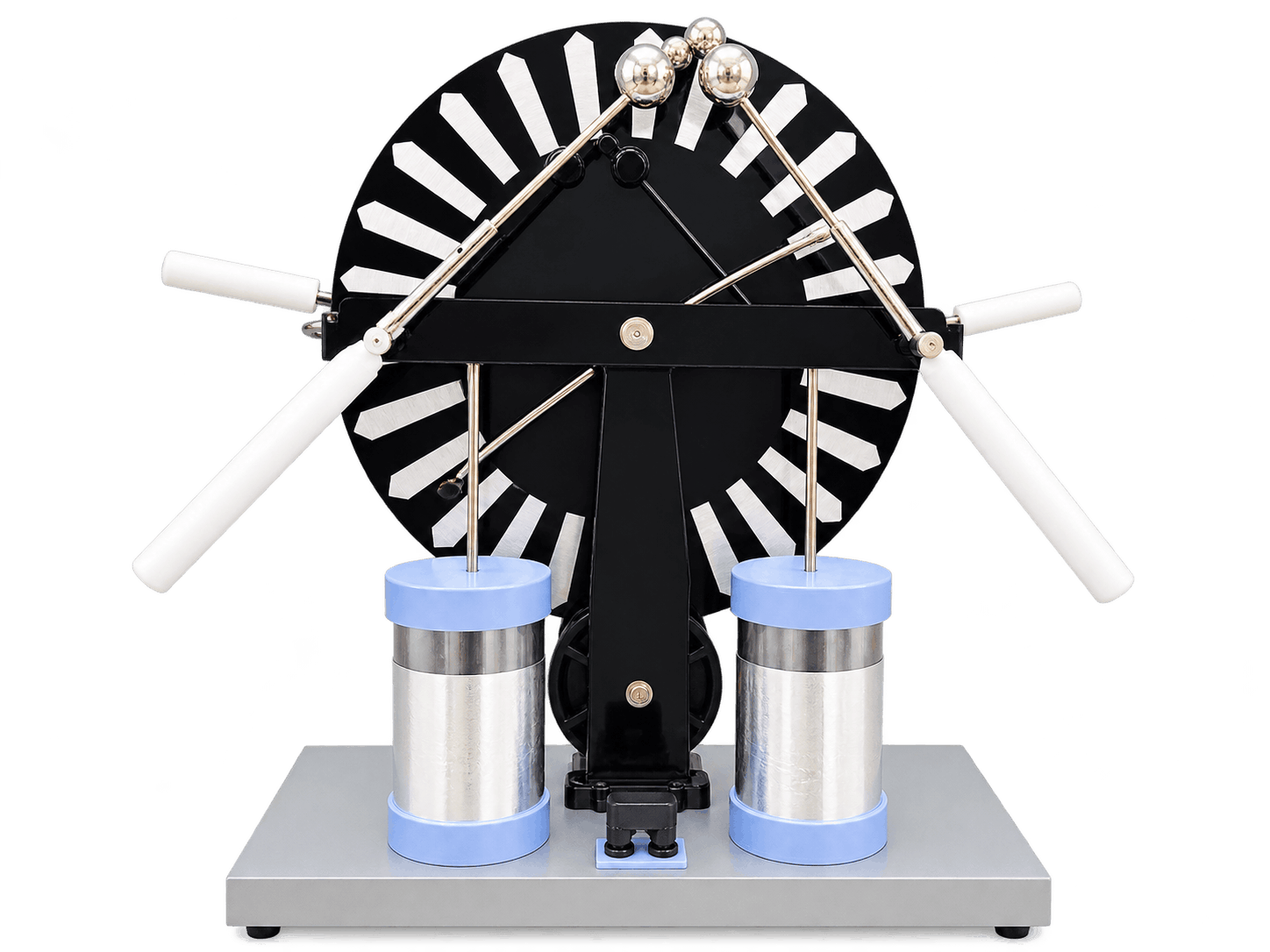
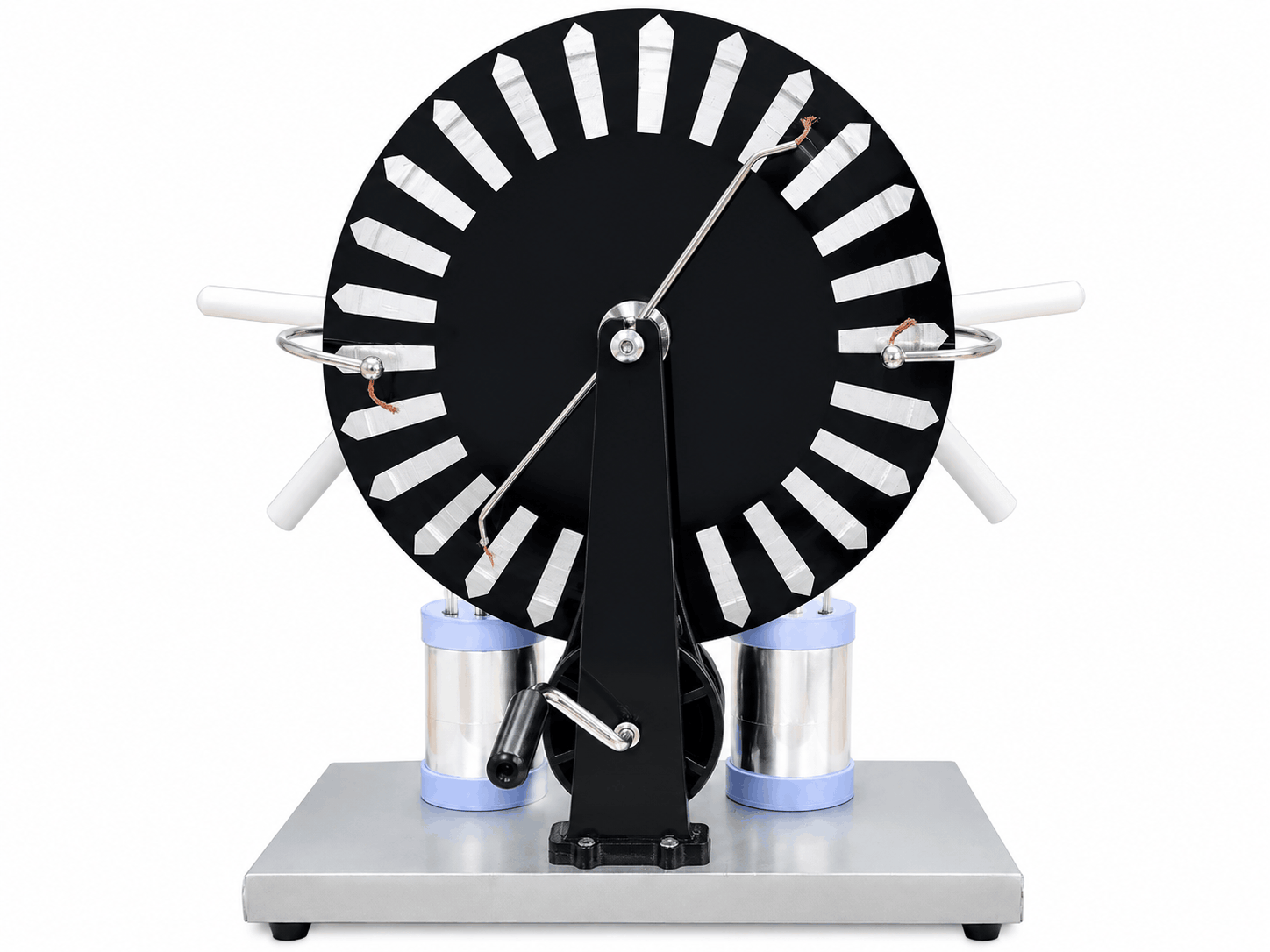

The High-Voltage Wimshurst Machine is designed for clear and practical demonstrations of electrostatic phenomena. It consists of two rotating disks fitted with metal sectors, a hand-operated drive mechanism, collecting combs, discharge terminals, and two cylindrical Leyden jars for storing electrical charge.
As the disks rotate in opposite directions, electrostatic induction separates and accumulates electrical charges. The charges are collected and transferred to the output terminals, where a high potential difference can produce visible sparks when the terminals are brought sufficiently close together.
Its mechanical design makes it suitable for classroom demonstrations, laboratory experiments, and hands-on learning. Students can explore how static electricity is generated, collected, stored, and discharged.
Key features and benefits
Generates a high electrostatic potential through mechanical rotation, without an external electrical power supply.
Demonstrates the breakdown of air under a sufficiently strong electric field.
Store separated electrical charge and help demonstrate electrostatic energy storage.
Helps students connect theoretical physics concepts with visible experimental results.
The machine works through electrostatic induction rather than relying on friction to generate charge.
Turn the handle to rotate the two insulating disks in opposite directions.
The metal sectors and neutralizer brushes interact to induce and amplify charge separation.
The collecting combs transfer charge to the output terminals and Leyden jars.
When the electric field is strong enough, a spark can jump across the gap between the terminals.
The Wimshurst Machine can be used for the following physics demonstrations:
| Experiment | What students learn |
|---|---|
| Electrostatic spark generation | High potential difference and electrical discharge |
| Charge separation | Positive and negative electrical charges |
| Electrostatic induction | How electric charges redistribute in response to an electric field |
| Leyden jar demonstration | Electrical charge storage and capacitance |
| Spark-gap variation | The relationship between electrode distance and discharge |
| Conductors and insulators | How materials affect charge movement and insulation |
| Dielectric breakdown | How an electric field can cause air to conduct electricity |
| Electrostatic effects | Observable effects of static electricity |
Perfect For
-
School and college physics laboratories.
-
University electrostatics demonstrations.
-
Science museums and educational exhibitions.
-
Teaching electrostatic induction and charge separation.
-
Demonstrating high potential differences and spark discharge.
-
Practical demonstrations of capacitors and dielectric breakdown.
-
Student projects and introductory experimental physics.
Important Safety Notice
High-voltage equipment
-
Do not touch the discharge terminals or metal conductors during operation.
-
Keep sensitive electronic devices away from electrical discharges.
-
Keep users at a safe distance during demonstrations.
-
After use, discharge the Leyden jars and terminals using the appropriate procedure and a suitable discharge tool, following the laboratory’s safety instructions.
-
Operation should be supervised by a trained instructor or laboratory technician.
-
People with pacemakers or other implanted electronic medical devices should avoid exposure unless cleared by their medical device guidance and the laboratory’s safety procedures.